
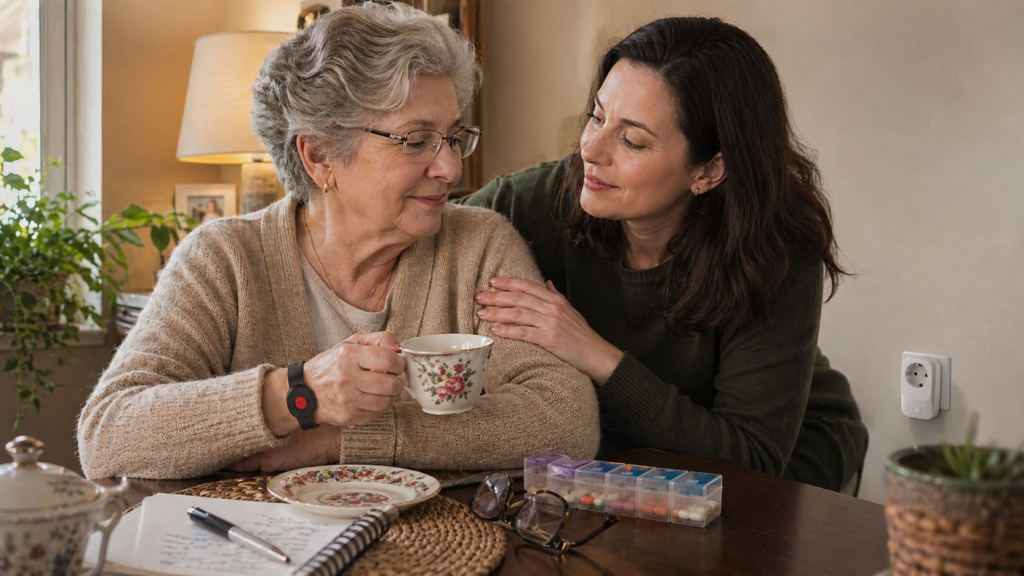
Realising that a parent is starting to need more support at home rarely happens overnight. It usually creeps in between phone calls, visits and unspoken pauses. Sometimes it is hard to see, because we want to keep picturing them strong, or because they themselves play down what is happening. But the instinct that brought you to this article deserves attention. Noticing in time is not invading their independence: it is the best way to protect it. The earlier you spot certain signs, the more options you have to decide, together, how to move forward.
The 5 signs worth looking at calmly
1. Changes in daily routine
Older adults tend to lean heavily on their routines: morning coffee, the mid-morning walk, the Sunday phone call. When that routine starts to fray (skipping meals, going to bed at unusual hours, no longer popping out to the usual market) it is often one of the first hints that something is shifting.
What matters is not a single day but the pattern. Have they gone several weeks without doing the shopping the way they used to? Do they fall asleep mid-afternoon and then fail to rest at night? These sustained changes speak louder than any test.
Be careful not to confuse it with a quiet patch or simply wanting to rest more. Before jumping to conclusions, ask without an agenda: “How have you been sleeping lately?”, “Fancy going to the market together?”. An open conversation reveals far more than an interrogation.
2. Neglecting personal care
The state of the home and personal grooming usually go hand in hand. The same clothes worn several days in a row, a different smell than usual, fridges with expired food, dishes piling up… these are signs to take seriously without dramatising.
Often it is not about “letting themselves go”, but about very specific issues: it is hard to bend down to step into the bath, they cannot read labels well anymore, their sense of smell has faded so they do not notice odours. Spotting the real cause completely changes the solution.
When you bring it up, avoid “you are neglecting yourself”. Something like “the bathtub looks high, what if we had a look at a seat for it?” works much better. Talking about concrete solutions hurts less than receiving a judgment about who you are.
3. Lapses that did not happen before
Forgetting an appointment or misplacing keys happens to all of us. What deserves attention is when lapses appear that did not happen before: leaving the stove on, repeating the same story several times in one conversation, not remembering whether they took their medication or taking it twice.
Do not confuse a one-off slip with sustained memory loss. And do not assume the worst either: there are reversible causes (dehydration, lack of sleep, side effects of drugs, depression) that can look like dementia and are not.
If the doubt persists, the most useful thing is to jot down concrete examples for a couple of weeks and discuss them with their GP. Arriving with data (what happened, when, how often) is far more helpful than saying “I find them more distracted”.
4. Trouble climbing stairs or keeping balance
Falls are one of the main causes of lost autonomy in older adults. And they almost always give warning signs: holding on to the handrail where they did not before, stopping halfway up the stairs, walking more slowly, avoiding getting up from the sofa unaided.
Do not confuse passing tiredness with a deeper change. What matters is whether that difficulty is sustained or increasing. A rug that used to be harmless can now be a real risk. A bathroom without grab bars, too.
Talking about it is delicate, because pride comes into play. It is better to focus the conversation on the house, not on them: “mum, this rug has always been crooked, shall we take it out?”. Small adjustments (a night light in the hallway, grab bars in the shower, closed shoes indoors) drastically reduce risk without making them feel “treated like an old person”.
5. Social isolation
Isolation is a silent but very powerful sign. Stopping the meet-ups with lifelong friends, not wanting to go down to the bench in the square, avoiding calls, switching off the TV and sitting for hours doing nothing… all of it directly affects mood and, in the medium term, health.
It is important to tell apart needing more quiet (something natural with age) and pulling away from the world. The difference usually lies in desire: if they used to enjoy those plans and now systematically refuse them, it is worth asking why.
Sometimes there is fear behind isolation (of falling in the street, of not reaching the bathroom in time, of not hearing well in a group). Solving that specific fear often brings social life back. And if the cause is low mood or unresolved grief, talking to their GP is the best first step.
When to seek professional help
If several of these signs appear together, or if one of them holds over time, it is worth consulting their GP and, if recommended, a geriatrician or social worker. You are not “overreacting”: you are doing the right thing.
Beyond professional support, many families decide to complement everyday life with discreet technology. If you choose to add a home monitoring system, look for one that respects your loved one’s privacy and notifies you only when it matters. That is what we do at Vitalkeep: detecting falls, unexpected exits or prolonged inactivity without cameras and without microphones. If you would like to know more, feel free to get in touch with no commitment or visit our help centre. Whatever you decide, take it at your own pace.